
Understanding Frontend vs. Backend
You hear the terms 'Frontend' and 'Backend' constantly, but what do they mean for your business? We break down the two halves of your software using a simple analogy to explain where your money goes and how your app works.
Table of Contents
Expand
When we start a new project, the conversation almost always zeroes in on what the user sees. “I want a dashboard here.” “The button should be blue.”
Clients focus on the UI because it’s the only part they can actually see. It’s an understandable mistake, and it leads to expensive technical debt later. The interface is only about 20% of the work. The rest is hidden beneath the surface, quietly driving the engine of your business.
To build something that works, you need to understand the relationship between the frontend and the backend. And honestly, the clearest way to explain it isn’t with code. It’s with a restaurant.
The Frontend: The Dining Room (Experience)
The frontend, the client-side, is everything your customer actually touches. In our analogy, that’s the dining room. The décor, how comfortable the chairs are, the layout of the menu, the plates the food arrives on.
It’s More Than “Looking Pretty”
A lot of owners assume frontend just means graphic design. It doesn’t. It’s really three disciplines working together.
UI is the look: colors, fonts, branding, whether it reads as professional and trustworthy at a glance. UX is the feel: does a button react instantly when clicked, or does the navigation leave people lost and confused? And interaction logic is the code running live in the browser. Type an invalid email and watch the box turn red before you even hit submit. That’s frontend code catching the problem before it ever reaches the server.
A great backend paired with a bad frontend is a five-star chef serving dinner in a dirty, confusing dining room. Customers won’t stick around long enough to taste the food. Under our subscription model, we handle continuous frontend maintenance, so your “dining room” stays current as what users expect keeps shifting.

The Backend: The Kitchen (Logic & Data)
The backend, server-side, is everything happening out of sight. This is the kitchen. Guests never see the ovens or the walk-in freezer, but strip those out and the restaurant is just a room full of empty tables.
Start with the database, your pantry. It stores customer lists, inventory, transaction history, pricing. Disorganized pantry, disorganized business. Then there’s the logic, your chef. The database holds the ingredients, but logic is what actually cooks them. A user logs in, and logic checks the password and confirms the subscription’s active. A user buys something, and logic calculates tax and updates inventory in the same breath. And finally security, your health inspector. The backend is the gatekeeper making sure User A can never see User B’s credit card, encrypting sensitive data, and keeping the bad actors out.
The backend is your operational stability, full stop. Our Software Dept partnership keeps your backend up to code, secure, and tuned as the business scales. We don’t launch and vanish. We run the kitchen so it never becomes the thing slowing your growth down.
The API: The Waiter (The Connection)
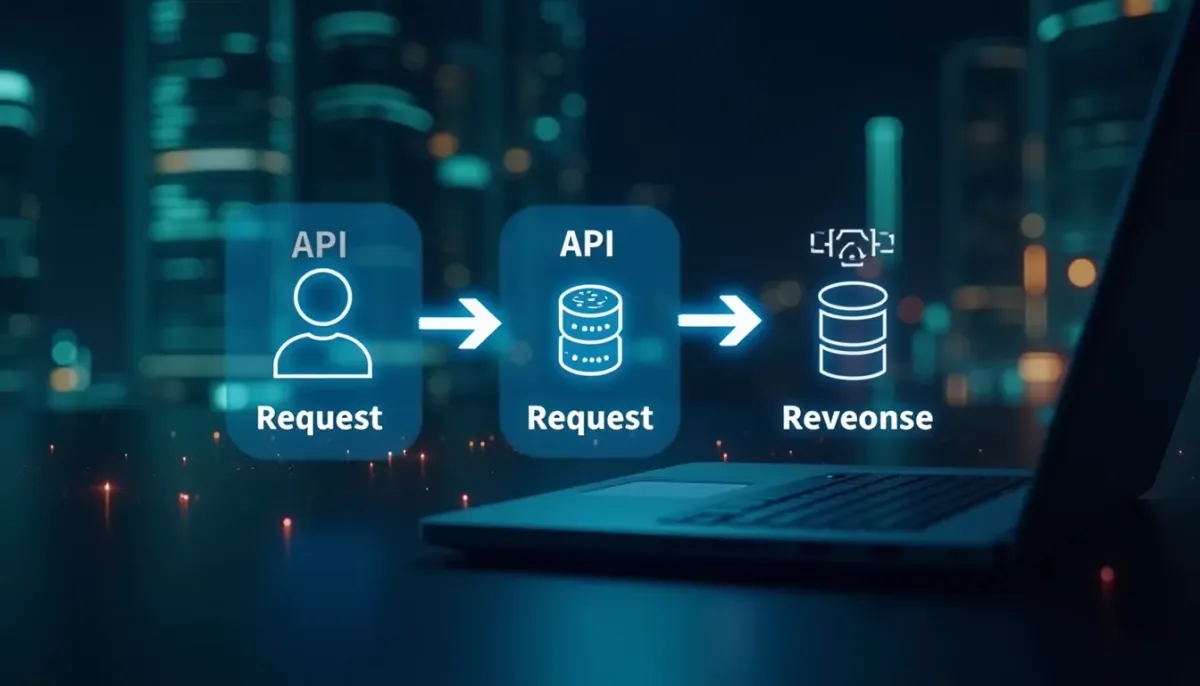
So how does the dining room actually talk to the kitchen? You don’t shout your order straight at the chef. You tell the waiter. In software, that waiter is the API, the Application Programming Interface.
You click “Checkout,” and the frontend hands the order to the API. The API carries that data securely back to the server. The server processes the payment and tells the API “success.” The API runs the message back to the frontend, and you see a “thank you” screen. Every checkout you’ve ever done ran through this exact relay.
Why You Need “Full Stack” Expertise
We run as a full-stack shop. We design the dining room, and we build the kitchen.
Hire a designer who doesn’t understand backends, and they’ll design features that are either impossible or brutally expensive to actually build. Hire a backend engineer who doesn’t understand design, and they’ll build a system so confusing your own employees refuse to touch it.
We bridge that gap on purpose, keeping the frontend intuitive while the backend stays solid and secure underneath it.
Ready to build? Got a specific project in mind? Use our Ryse estimator to ballpark the fixed-price cost of building your whole “restaurant” from the ground up.
Related Topics
About Ryse Software
We are a software engineering partner that makes it easy for teams to design, build, and evolve custom software, from early experiments to long-term systems.
If this article was useful, and you’re thinking about software in your own business, we’re happy to talk through options and tradeoffs.
A clear discussion, no pressure and no pitch.