The Pareto Paradox: Why WordPress and Shopify Eventually Fail Growing Businesses
Platforms like WordPress and Shopify are incredible starting lines, but terrible finish lines. Learn the 'Business Physics' of when to use them, and exactly when they start holding you back.
Table of Contents
Expand
A confession, right up front: we host over 200 WordPress sites.
So no, we don’t hate WordPress or Shopify. Brand-new business, standard requirements, shoestring budget? Use them. They’re engineering miracles that let you launch for pennies.
But we also see the aftermath. The panic when a Shopify store is bleeding $3,000 a month in “app fees” just to get one specific checkout flow. The despair when a WordPress site gets hijacked because one of its 47 plugins had a security hole left open since 2019.
The software isn’t the villain here. The trouble starts when you ask a generic tool to carry your unique business logic.
The Pareto Paradox (The 80/20 Trap)
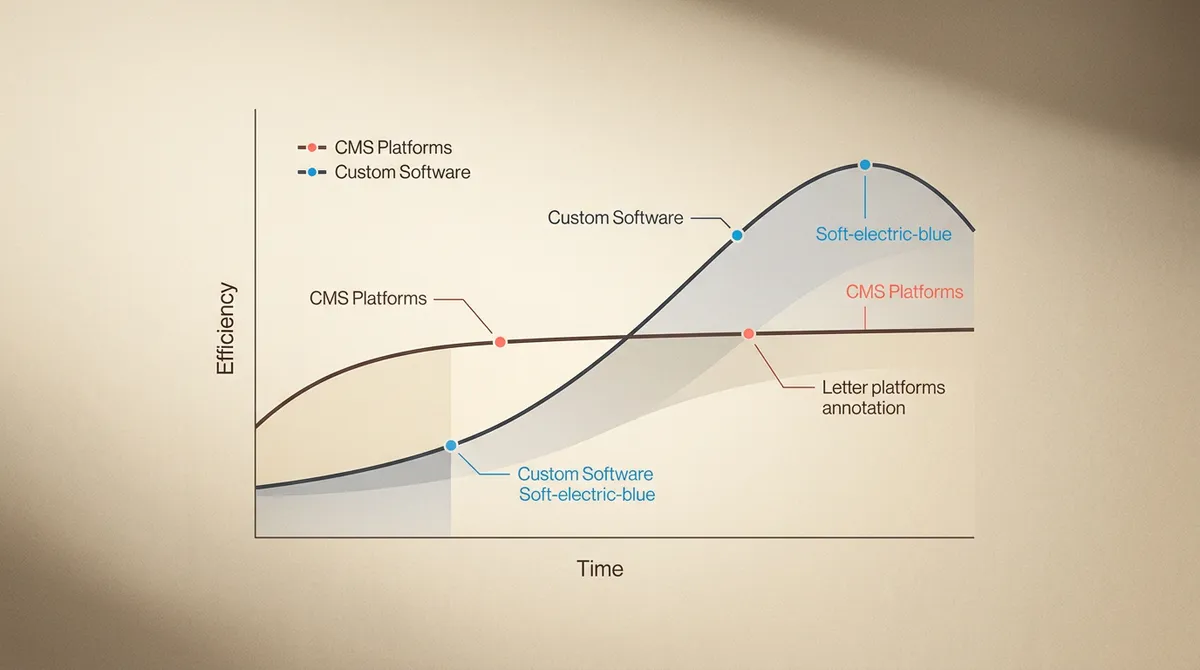
In software, the 80/20 rule is a trap. WordPress or Shopify hands you 80% of what you need instantly, for almost nothing.
It’s the other 20% that gets you. The custom features that actually make you competitive will cost roughly 500% more to force into those platforms than they would have cost to build custom from the start. So you start cheap and fast, then burn your growth capital wrestling your own tools.
When to Stay on the Platform
We’re not snobs about this. Off-the-shelf has its moment.
Use WordPress if your content is the product. You’re a blog, a news site, a marketing brochure. WordPress was built for publishing, and it’s still the king of getting words on a page. Same goes if your needs are genuinely standard: a contact form, an About page, a blog. Don’t reinvent the wheel for basic web presence.
Use Shopify if you’re a retailer, not a tech company. You sell t-shirts or candles, and you need a cart, a checkout, and shipping labels. Same if you’ve got zero budget and just need to prove the idea works before spending a dime on code.
The Dark Side: When Platforms Turn Toxic
1. The “Franken-Site” Architecture
WordPress runs on a stack that’s effectively twenty years old. To make it feel modern, people bolt on plugins. Then more plugins.
Before long you’ve got 50 plugins from 50 developers who never spoke to each other. They conflict. They bloat the database. And they break something new every time you hit “update.”
2. Digital Sharecropping
Shopify is a gorgeous walled garden. You just don’t own the land. Want to change your checkout logic for a complex B2B wholesale calculation? Shopify says no, unless you jump to Shopify Plus (starting north of $2,000 a month) or rent a stack of pricey third-party apps.
3. Security by Design
WordPress powers 40% of the web, which makes it the number-one target for hackers. Automated bots scan the internet around the clock hunting for outdated plugins. Custom software is a stealth fighter next to that. It has no “known vulnerabilities,” because the code is unique to you.
The Switch: Moving to Custom Software
You know it’s time to leave the platforms when your business logic becomes your competitive advantage.
Sell shoes? Use Shopify. Sell shoes with a unique try-before-you-buy flow wired into custom warehouse scanners? Build custom software. We bridge those hardware gaps by building the APIs and interfaces that make your physical equipment talk to your digital systems.
And moving off the platform doesn’t require a giant one-time check that wrecks your cash flow. Through our subscription model, you treat us as your internal software department starting at $2,500/month. A dedicated partnership that scales with you, with the software licensed to you while the subscription is active.
The Bottom Line
If your business fits in a box, buy the box. It’s cheaper. Really.
But if your business is breaking out of the box, if you’re spending more time fighting your tools than serving customers, stop paying rent on a box that doesn’t fit. Custom software is faster, more secure, and often cheaper than the “rent” you hand these platforms to keep holding you back.
Ready to see what the switch looks like? Use our estimator tool for a rough idea of scope and cost on a fixed-price project. Or contact us and we’ll talk through the monthly partnership model.

Related Topics
About Ryse Software
We are a software engineering partner that makes it easy for teams to design, build, and evolve custom software, from early experiments to long-term systems.
If this article was useful, and you’re thinking about software in your own business, we’re happy to talk through options and tradeoffs.
A clear discussion, no pressure and no pitch.