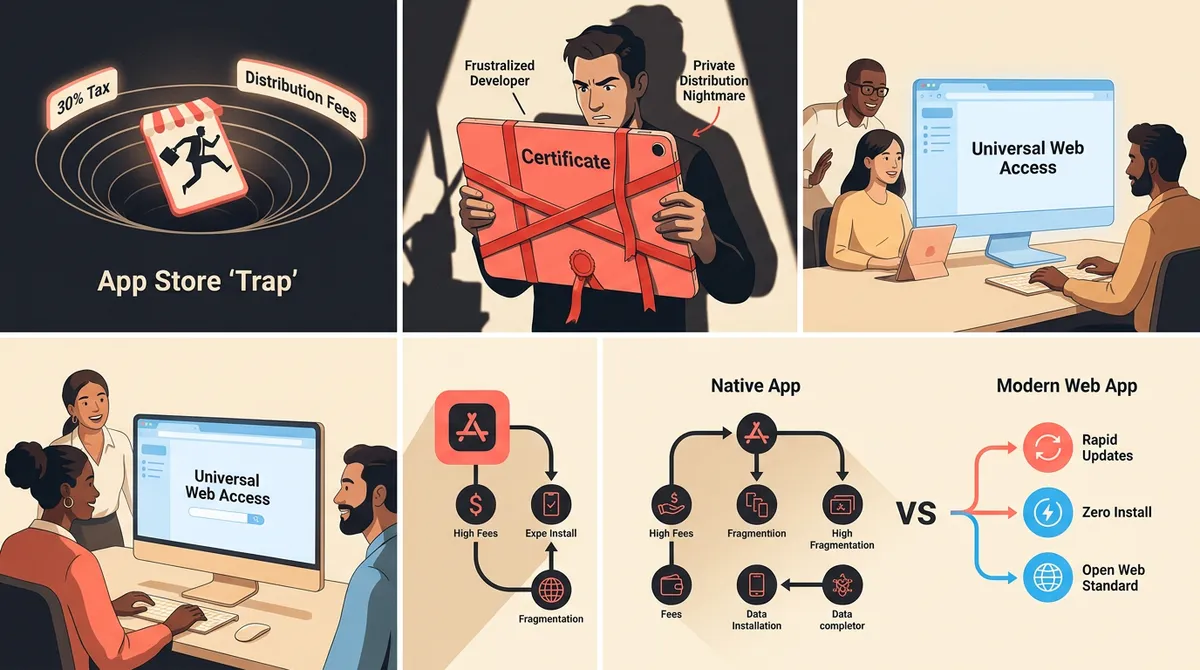
The App Trap: Why Smart Businesses Are Choosing the Web Over the App Store
The allure of an App Store presence is strong, but the reality is often a financial trap. We deep dive into the hidden costs of the 'Apple Tax,' the nightmare of private distribution, and why the modern Web is the smarter investment.
Table of Contents
Expand
The home screen is the most expensive real estate on earth. It’s also where most business owners waste their first $50k.
Look at your phone. Spotify, Uber, Instagram. To an owner, that little icon reads as legitimacy. So when companies start digitizing, the first instinct is almost always the same: “we need an app.”
But there’s a huge gap between a consumer app and the tools you need to actually run a business. We’ve watched companies pour giant budgets into native iOS and Android apps, then realize months later they’d walked straight into a cycle of gatekeepers, diminishing returns, and taxes they never saw coming.
The Economics: The Apple Tax and Margin Destruction
Build an app to sell a service, a subscription, a course, premium content, and you’ve entered a forced partnership. Charge $100 inside your app and Apple or Google want a 15% to 30% cut.
And you can’t just link out to your website to dodge it. That’s called “steering,” and it’s flatly against the rules. Try to keep your own revenue and they’ll reject the app or ban the account.
Do the math. On the web, you sell a $100 product, credit card fees take about $2.90, and you keep $97.10. In a native app, you sell that same $100 product, Apple takes $30, and you keep $70. For a business running on normal margins, losing 30% off the top is the line between profit and failure.
Our partnership model includes architecting those high-margin payment flows so the $97.10 lands in your bank account, not someone else’s.
The Operational Trap: The Myth of “Build Once”
Frameworks like Flutter and React Native let you write the code once. They don’t fix the administrative headache. You’re still juggling multiple store listings, unique screenshots for every device size, and two separate review boards.
And then there are the updates. Say you ship a critical release Tuesday morning and find a bug that crashes the app for 10% of your users.
On the web, we push a fix and thirty seconds later everyone has the corrected version. On the App Store, we submit the fix, it drops into a queue, an Apple employee reviews it, and maybe they approve it Thursday. Or Friday. For three days your customers are broken and you’re powerless to help them.
The Distribution Nightmare: Internal Tools
This is the big one for internal software. Say you have 50 drivers and you want an app to track deliveries. You almost certainly don’t want that thing public on the App Store.
Apple makes it genuinely hard to install apps from outside their store. To get a private app onto employee iPhones, you register for Apple Business Manager, verify a corporate D-U-N-S number, and grind through a rigorous verification process.
And if your team uses personal phones, they’ll often flat-out refuse to install the device-management profiles private distribution requires. We’ve watched internal projects stall for months over these hurdles. Not the code. The paperwork.
The Solution: The Progressive Web App (PWA)
For 95% of businesses, the answer is a Progressive Web App. A PWA is a web application engineered to behave like a mobile app. You reach it through a normal URL, but it can do things ordinary websites can’t.
Here’s why it wins. Users can tap “Add to Home Screen,” and the PWA drops an icon on the phone, the browser bars vanish, and it feels native. There are zero gatekeepers, so you never wait on a review to launch or to ship an update. You own the channel. Modern PWAs also work offline, storing data on the device so an employee who loses signal keeps working and syncs back up later. And one build runs on iPhone, Android, Windows, and Mac.
When a Native App Is Necessary
Native apps aren’t dead. They have real use cases where the friction pays for itself. Go native if you’re a consumer brand, a gym chain or a big retailer, where customers genuinely expect to find you in App Store search. Go native if you need deep hardware access, like talking to Bluetooth medical devices, LiDAR scanners, or background biometrics. And go native for high-end gaming, where you’re squeezing the phone’s GPU for heavy 3D rendering.
The Verdict: Strategy Over Vanity
Building an app should come down to ROI, not vanity. Build on the web and you save on development and maintenance, keep 100% of your revenue, and control your own distribution.
We lead with PWAs through our subscription model, acting as your internal software department and shipping continuous updates without the App Store friction. Your software is licensed while your subscription is active, so you get continuity, not just a one-time launch.
Before you sign for a mobile app, ask one honest question. Do I need the phone’s hardware, or do I just want the icon? If it’s the icon, the web can give you that. Without the tax.
Got a specific project with a defined scope and timeline? Use our project estimator tool for a fixed-price estimate.

Related Topics
About Ryse Software
We are a software engineering partner that makes it easy for teams to design, build, and evolve custom software, from early experiments to long-term systems.
If this article was useful, and you’re thinking about software in your own business, we’re happy to talk through options and tradeoffs.
A clear discussion, no pressure and no pitch.