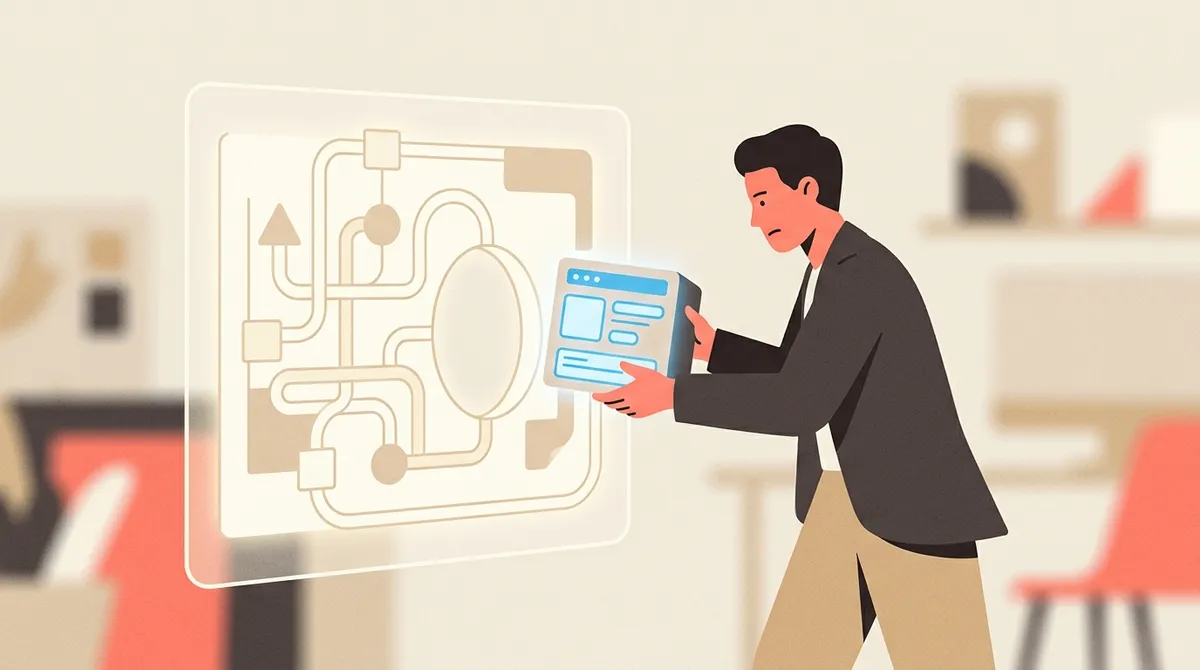
The Low-Code Trap: Why Drag-and-Drop Fails Growing Businesses
Low-code tools promise speed but often deliver technical debt. Learn when to use them and when they'll inevitably break your business processes.
Table of Contents
Expand
Low-code platforms promise a shortcut. Drag a few boxes, wire up a spreadsheet, and suddenly you’ve got a working app without writing a line of code. It feels like a superpower. Then your business starts to grow, and the feeling fades.
Here’s the thing these tools rarely tell you: they’re built for speed, not scale. They’re great for testing a new idea or throwing together a prototype. Build your core operations on one, though, and you’ve installed a glass ceiling you can’t see yet.

When you lean on these platforms, you’re really renting someone else’s limitations. You don’t own the logic underneath, and you don’t own the infrastructure. What you’re quietly building instead is technical debt. That’s the future cost of rework you take on by picking the easy option now instead of doing it properly.
The Allure of the Quick Fix
Owners reach for low-code because it pays off instantly. You’re drowning in spreadsheets, and a working internal tool by Sunday night sounds like salvation. It skips the whole development cycle. It also distracts your budget from the real problem.
That’s the honeymoon. You connect Airtable to a couple of automations, and manual data entry just disappears. For a small team, it’s a genuinely handy band-aid. Fast, clean, and you feel clever for dodging the engineers.
Then that success feeds a dangerous myth: the “citizen developer.” The idea that anyone with a login can build and maintain enterprise-grade systems. A manager can build a form, sure. Ask them about database normalization or scalability and you get a blank stare.
The “citizen developer” is often a frustrated employee building a temporary raft that the business later tries to sail as a cargo ship.
What began as a side project becomes mission-critical, and nobody knows how to fix it when it breaks. You didn’t save money. You moved the cost of professional engineering onto your staff’s productivity. Our FAQ covers how we handle the move from these DIY tools to real systems.
Where Low-Code Hits the Wall
The honeymoon ends when your needs outrun the platform. You can build 80% of the app in a few days. It’s the last 20%, the custom logic that actually runs your business, that turns out to be impossible or held together with a nightmare of hacks.

Performance is usually the first crack. As your data grows, these tools drag. And it’s worse than slow load times. You start hitting hard walls on record counts and API rate limits.
Then comes the gut-punch moment for a founder: the critical feature you need simply isn’t supported. Own your software and you build whatever the business requires. Rent a platform and you’re stuck waiting on their product roadmap.
The Integration Nightmare
Most low-code platforms are walled gardens. Easy to use their tools, hard to get your data out. Without deep API access, you’re forced to lean on connectors like Zapier or Make as fragile glue holding everything together.
That glue makes a house of cards. One third-party tool changes its authentication or renames a single field, and the whole workflow falls over. Before long you’re spending more time babysitting the connectors than using the software.
The result is data silos. Information trapped in systems that were never meant to work together. And once that happens, you lose the single source of truth you need for reports you can actually trust.
The Hidden Economics of ‘Cheap’ Tools
Low-code sells you a low entry price. Scale up, and the total cost tells a very different story. You’re not just paying for a tool. You’re paying a growth tax that punishes you for succeeding.
Most platforms charge per “seat.” Fine at three people. A margin-killer at fifty. Custom software usually carries no per-user fee at all. Then there’s the cost of workarounds: every business rule the platform won’t support gets paid for in technical debt, as your team builds triggers, hidden spreadsheet tabs, and connector hacks instead of clean logic. And the big one is vendor lock-in. Build your logic inside a proprietary environment and you don’t own the intellectual property. You can’t just export the app and move it to your own server.

When Low-Code is the Right Choice
Low-code isn’t bad. It’s just often used for the wrong job. Validating a risky new idea? Building a Minimum Viable Product? It’s the fastest path there is. It lets you find out whether customers will actually pay before you commit to a full build.
The ‘Disposable Software’ Mindset
The sharpest founders treat this stuff as disposable. They build an internal tool fully expecting to throw it away once it hits a certain milestone.
Every low-code experiment should have a “sunset date.” A point you decide in advance where the tool retires and a real system takes over.
That boundary is what stops technical debt from creeping in. Maybe you rule that once a process handles more than $10,000 a month, or touches more than ten people, it graduates to a custom build. Your operations stay nimble, and no temporary fix hardens into a permanent bottleneck. Here’s more about how we help companies make that jump.
Transitioning to a Real Foundation
Knowing when to graduate is the whole game. You’ve outgrown your stack the moment your team spends more time managing the tool than doing their jobs. If you’re hiring people specifically to babysit databases or re-run failed automations by hand, you’re propping up a broken system with expensive human labor.

At Ryse, we build for your business three years from now, not three weeks. That means architectural integrity: a data structure that can carry complex reporting and high transaction volume without buckling. It also means treating software as an asset, not a monthly utility bill.
Invest in a custom build and you’re creating intellectual property that raises the value of your company. Our subscription model works like your own internal software department, giving you the continuity and expertise to scale. We take you from a pile of disconnected tools to one unified system, licensed to you for as long as we’re partners.
Stop Patching, Start Building
The most expensive software you’ll ever buy is the one you have to build twice. If you’re living in technical anxiety, too scared to change a single field in case it takes down the whole company, you’ve hit the limit.

So do a cold audit of your tech debt. Add up the real monthly cost of your “simple” tools plus the revenue you lose to platform limits. Most owners find the “cheap” path is quietly costing them a fortune in drag.
Getting a realistic estimate for a fixed-price custom build comes down to defining the functional requirements: the specific things your software has to do to make money. Stop fighting your tools. Start building the system your business actually deserves.
A quick checklist before you decide:
- Audit your “glue”: count the Zapier tasks and manual workarounds currently holding your workflow together.
- Check the “growth tax”: add up your per-user licensing for the next twelve months if you double headcount.
- Find the wall: name three features your platform can’t support that would make you more efficient today.
- Get a reality check: use our estimator tool to see what a professional, fixed-price build looks like for your workflow.
Ready to graduate from low-code? Book a consultation with Zach and Chris and we’ll talk through how the partnership model turns your software into a real asset.

Related Topics
About Ryse Software
We are a software engineering partner that makes it easy for teams to design, build, and evolve custom software, from early experiments to long-term systems.
If this article was useful, and you’re thinking about software in your own business, we’re happy to talk through options and tradeoffs.
A clear discussion, no pressure and no pitch.