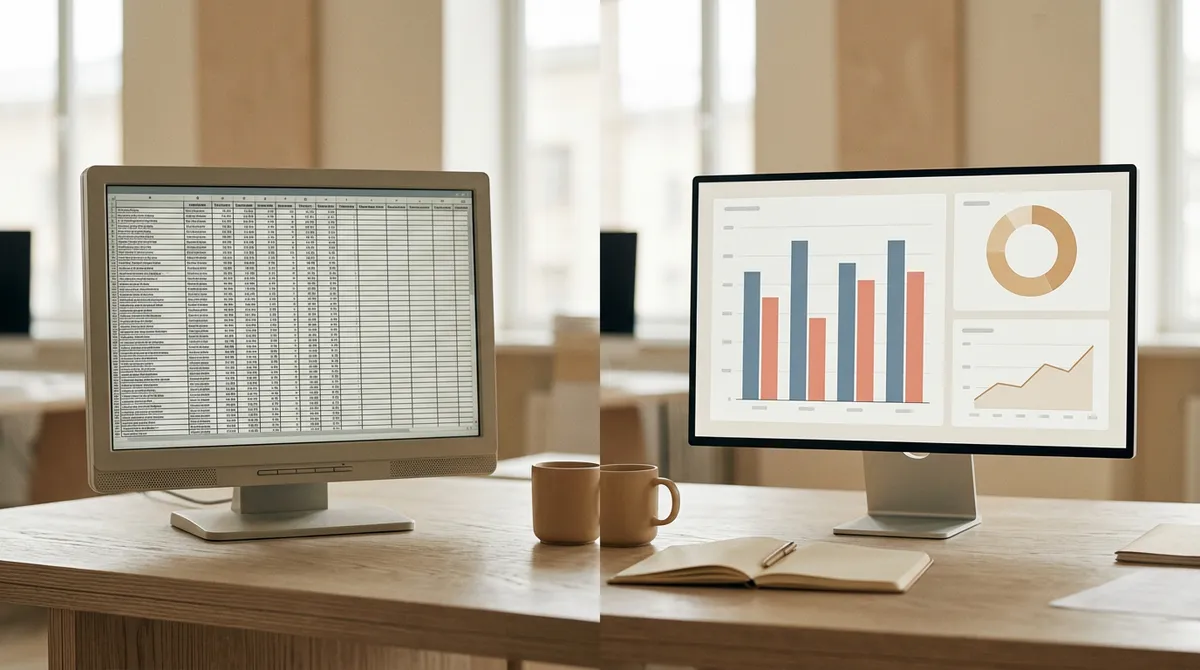
Beyond the Spreadsheet: When a Custom Dashboard Becomes Essential
Stop wrestling with data. Learn when a custom dashboard beats a spreadsheet for business insights, control, and growth.
Table of Contents
Expand
A business often starts with a spreadsheet. The universal tool, really. For tracking, organizing, analyzing. But what happens when that trusty spreadsheet, once your clearest view, becomes a tangled mess? When it swells beyond basic data entry into a labyrinth of formulas, tabs, and manual updates? That’s when the question pivots from “How do I manage this?” to “Do I actually understand this?” The leap from a sprawling spreadsheet to a focused custom dashboard isn’t just an upgrade. It’s a fundamental shift in how you grasp, and act on, your most critical business info.
The Data Dilemma: From Spreadsheets to Clarity
Every business lives or dies by its data. Sales figures. Inventory levels. Customer interactions. Project progress. Initially, a spreadsheet seems perfect. Flexible. Accessible. You can build it yourself. For smaller ops or isolated tasks, it absolutely works.
But as a business scales, so does its data. What began as simple rows and columns morphs into complex workbooks. Multiple versions float around. Mistakes creep in. Updates become a constant chore, prone to human error. The time spent collating, cleaning, interpreting data starts to outweigh any insights gained. You’re no longer using data to drive decisions, you’re just trying to keep your head above it. That initial clarity vanishes, replaced by a nagging uncertainty. This is the heart of the custom dashboard vs. spreadsheet dilemma: recognizing when your DIY solution has become a liability.
When Spreadsheets Hit Their Limit
Spreadsheets are brilliant for what they are: powerful calculators, excellent data organizers. Yet, they inherently limit, especially when pressed into service as a primary business intelligence tool.

Consider the practical headaches. Data integrity is a constant battle. One mistyped formula, one deleted row, and your entire reporting can be compromised. Version control? A nightmare. Which “Q4 Sales (Final V3) (Chris’s Edits)” is the actual final version? Security is often an afterthought. Sensitive business data just sits there. On a shared drive. In an email. And perhaps the biggest issue: real-time insights. Spreadsheets are snapshots. They demand manual updates, meaning your data is always a little bit old. You make decisions based on yesterday’s (or last week’s) numbers. This delay can mean missed opportunities, even worse, reacting too slowly to critical issues.
When your team spends more time battling the spreadsheet than understanding the business, that’s a clear signal. When you need to combine data from disparate sources, CRM, accounting software, marketing platforms, into one coherent view, a spreadsheet quickly becomes a Frankenstein’s monster of copy-pasting and lookup functions. This isn’t just inefficient, it’s a drag on growth.
The Case for a Custom Dashboard
A custom dashboard solves these problems by design. It’s a purpose-built view of your most important metrics, tailored precisely to your needs. Think of it: a control panel for your operations.
Accuracy and Consistency. A custom dashboard pulls data directly from its sources, often through automated integrations. This eliminates manual entry errors. Everyone sees the same information. No more conflicting reports.
Real-time Visibility. No waiting for weekly reports. Custom dashboards update frequently, sometimes in real-time, giving you an immediate pulse on your business. You see issues as they emerge, not after they’ve spiraled.
Actionable Insights. Instead of raw numbers, a dashboard presents data visually. Charts, graphs, key performance indicators (KPIs) highlight trends, flag anomalies. This makes complex information easy to digest, simple to interpret. Quicker, more informed decisions follow.
Security and Access Control. Custom solutions allow granular permissions. Only the right people see the right data. Sensitive info is protected. Audit trails track who accessed what.
Efficiency. Your team stops wasting hours on data collection, on formatting. Those hours instead go into analysis, into strategy, into execution. That’s a significant return.
The Decision Framework: Build or Buy?
The question isn’t if you need better data visibility, but how to get it. When considering a custom dashboard, businesses often stumble into a “build vs. buy” trap. Here, “buy” usually means a pre-built SaaS solution, while “build” means a custom application.
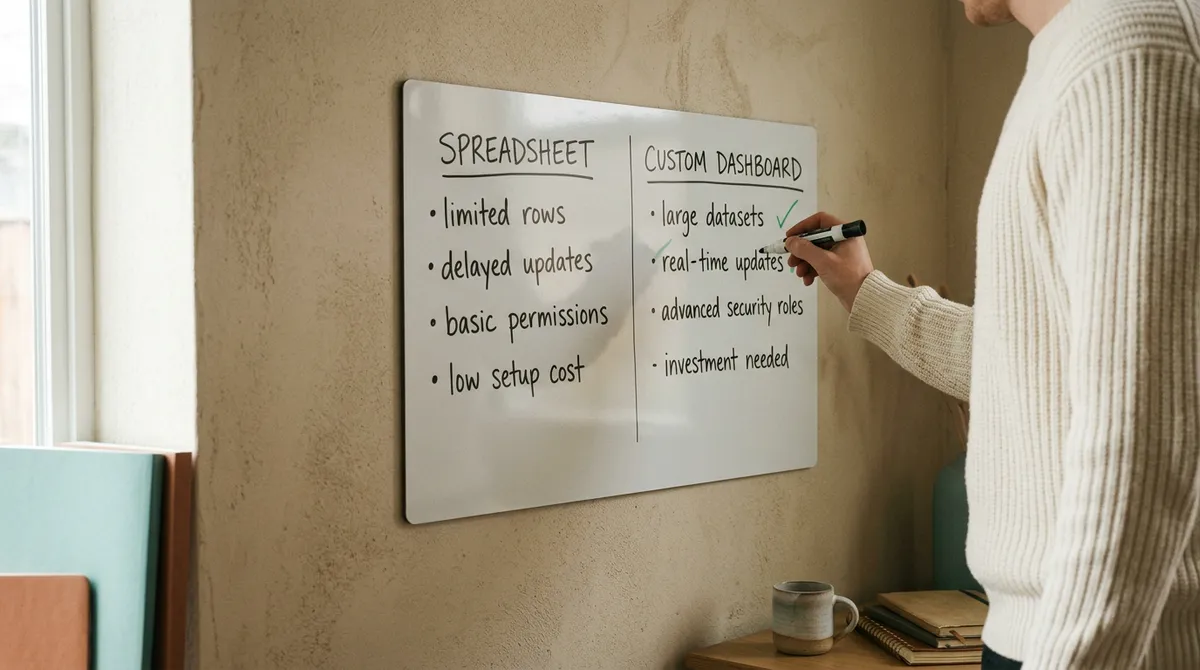
Here’s how to think about it:
- Complexity of Data Sources: How many different systems feed your data? If it’s more than two or three, and they don’t play nicely, a custom solution becomes very compelling. Off-the-shelf tools often struggle with unique integrations.
- Uniqueness of Business Logic: Does your business operate on standard metrics? Or do you have proprietary formulas, unique workflows, industry-specific KPIs? If your reporting needs are highly specialized, a custom dashboard provides the exact views you require, no compromise.
- Scalability: Are your data volumes growing quickly? Do you expect to add new business units or product lines? A custom solution can be designed to scale with you, sidestepping the limitations of fixed-feature tools.
- User Experience (UX): Who will use this dashboard? If it’s critical for daily operations across various departments, a highly intuitive, tailored UX ensures adoption and efficiency. Generic tools can feel clunky, irrelevant.
- “Nice-to-Have” vs. “Must-Have”: If clear data visualization is a competitive advantage, not just a convenience, then investing in a custom dashboard is a strategic move.
Sometimes, yes, a pre-built solution can work for standard reporting. But when your needs are nuanced, when your data is fragmented, or when your competitive edge relies on truly understanding your business at a glance, generic software rarely cuts it. You need something built to fit your business, not an approximation. This is where custom software development shines.
Making the Right Call for Your Business
Moving past the spreadsheet isn’t a small step, it’s a commitment to data-driven decision-making. It means investing in tools that provide clarity, not complexity.
Before jumping into any solution, ask yourself:
- What critical questions can I not answer with my current spreadsheets?
- How much time does my team spend each week on manual data tasks?
- What’s the cost of a delayed or inaccurate decision based on old data?
If the answers point to significant inefficiencies, missed opportunities, or a lack of real-time visibility, then a custom dashboard is likely essential. It’s about moving from reacting to predicting, from guessing to knowing.
Building custom software might sound intimidating, but it doesn’t have to be. We partner with businesses to build these exact solutions, treating your software needs as if they were our own. We act as your internal software department, without the overhead of hiring an entire team. Our subscription model ensures continuity, allows you to scale or pivot as your business evolves, starting at $2,500/month. We help you define what you need, build it, and maintain it, ensuring your data always serves you, not the other way around.
Ready to stop wrangling spreadsheets and start truly understanding your business? Let’s talk about what a custom dashboard can do for you. Contact us for a consultation.

Related Topics
About Ryse Software
We are a software engineering partner that makes it easy for teams to design, build, and evolve custom software, from early experiments to long-term systems.
If this article was useful, and you’re thinking about software in your own business, we’re happy to talk through options and tradeoffs.
A clear discussion, no pressure and no pitch.