
Build vs. Buy CRM: Why the 'Buy' Option Often Costs More Than You Think
The 'build vs. buy CRM' debate isn't just about upfront cost. It's about strategic control, adaptability, and long-term value for your unique business.
Table of Contents
Expand
Businesses squabbling over build vs. buy CRM usually fixate on price. Just the money. And yeah, that’s understandable. Grabbing an off-the-shelf solution can look like the smart financial move. Subscribe, maybe a setup fee, done. That’s the fairytale, right? But for heaps of businesses, the reality, once you properly account for long-term expenses, is radically different.
Plenty of companies dump fortunes into some pre-packaged CRM, only to later realize the actual spend exploded far past the pretty sticker price. Why? Simple: the software simply didn’t fit. And trying to hammer a square peg into a round hole? That inevitably costs more, in time, in cash, in sheer, soul-crushing exasperation.
The ‘Off-the-Shelf’ CRM Siren Song: Why Its Savings Are a Lie
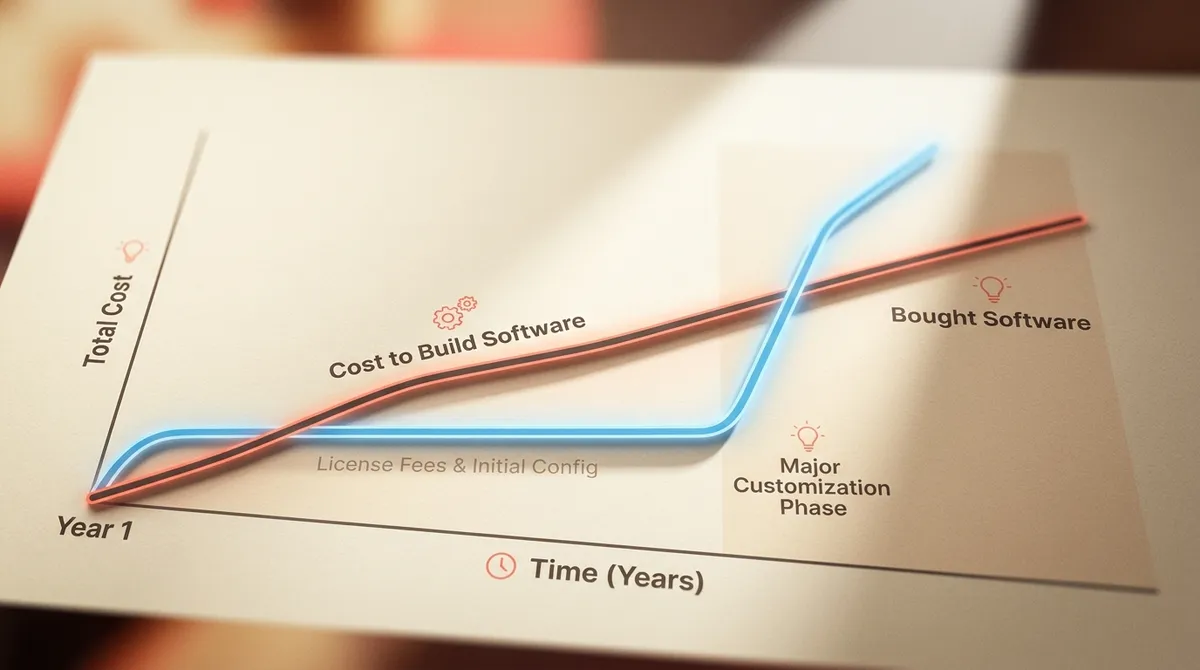
The siren song of buying off-the-shelf CRM is potent. Tiny upfront costs. Speedy deployment. It promises to magically solve everything without the drudgery of development. But those initial savings? Poof. Gone. Swallowed whole by hidden costs that inevitably surface for many.
Consider this: generic CRMs are built for everyone. So they’re bloated with features you’ll never touch. And they often critically lack the exact ones you desperately need. So what happens? You start customizing. You shell out for add-ons. You spring for integrations, just to make it talk to your existing tools. You hire consultants, hoping they can make it almost work with your peculiar processes. Every single step ratchets up the complexity, the cost, and your reliance on external vendors.
Then, there’s the insidious adaptation cost: how some off-the-shelf system forces your business to contort to its limitations, instead of the other way around. Your teams might twist their proven workflows into pretzels. Hello, inefficiency. Cue the user revolt. The software ends up dictating your operations. A disaster Waiting to Happen.
Your Business Isn’t Some Cookie-Cutter Template: Generic CRMs Just Don’t Cut It
No two businesses, ever, are truly identical. Not even within the same industry. Your sales cycle, your customer support protocols, how you onboard new clients, those are often unique. They’re your competitive edge.
Generic CRMs chase common business functions, broad market segments. They’re a solution for the masses. But your business? It’s got distinct operations. And when you try to cram those distinct operations into some rigid, pre-built system? You compromise. You hack together workarounds. You breed inefficient processes that will infuriate your employees and, eventually, your customers.
Picture your sales team. They navigate a specific data flow, a rhythm. Now, suddenly, they’re jumping through hoops, punching in redundant data, or, worse, secretly resorting to external spreadsheets because the CRM just won’t support their natural workflow. That’s not efficiency. That’s a productivity black hole disguised as a solution.
The Uncontestable Edge of a Custom-Built CRM
A custom CRM isn’t just software. It’s a strategic weapon. It’s forged from the ground up to perfectly mirror your precise business processes, to supercharge every workflow, to amplify your unique competitive advantages. Right from day one.
This gives you strategic control. You own the intellectual property. You can evolve it precisely as your business evolves, ignoring some vendor’s update schedule. There’s no useless ‘feature bloat’, every single component is designed to deliver specific value, just for you.
A custom CRM stands as a strategic asset, not merely some operational tool.
It means your teams get software that feels like their own. Because it is. This translates into rock-solid adoption rates, minimal training, and genuine, measurable efficiency gains. It solidifies your unique market identity.
When to ‘Build’: It’s More Than Just the Initial Outlay
The upfront investment for custom software can seem higher. But the long-term dividends? Massive. Think about building your own CRM when your business possesses distinct operational advantages, things that genuinely set you apart. These advantages are often far too precious to be diluted by some off-the-shelf software.
The real juice of a custom build lies in its agility and scalability. Your business expands? Your software grows right alongside it. No crazy expensive migrations. No limits on what you can do tomorrow. It integrates perfectly with your existing systems and any new tech you adopt. A custom CRM isn’t just a tool, it’s the bedrock for future innovation. You’ll react to market shifts faster, implement new strategies on a dime, and maintain that crucial competitive edge.
When you invest in custom CRM development, you’re not just buying code. You’re buying the freedom to adapt, to innovate, to thrive on your terms.
So, How Do You Even Approach Building Your Own CRM?
Building your own software doesn’t have to be some monumental, soul-crushing project. It begins with a razor-sharp understanding of your core business processes and the exact pain points you need to obliterate. Don’t just list features. Map the workflows. Pinpoint where the biggest headaches are right now.
Then, find a software partner that genuinely feels like an extension of your own business. Like an internal software department. This isn’t about hiring some agency for a one-off gig. It’s about forging a real relationship with a team that gets your goals, that provides ongoing support and evolution. Our subscription model is designed for exactly this: a devoted team working with you, month after month, delivering fast-paced development and total architectural oversight.
Focus on iterative development. That means launching with the most critical features, getting them into users’ hands quickly, then evolving the system based on real-world feedback. Don’t try to build the Taj Mahal all at once. Deliver value bit by bit. Adapt as your needs, and the market, fluctuate. Your CRM should be alive. Constantly improving. Just like your business, ideally.
Want to explore how a custom solution could genuinely boost your operations? We offer consultations. Drop us a line at hello@rysesoftware.com or just call us: +1 662-300-3910.

Related Topics
About Ryse Software
We are a software engineering partner that makes it easy for teams to design, build, and evolve custom software, from early experiments to long-term systems.
If this article was useful, and you’re thinking about software in your own business, we’re happy to talk through options and tradeoffs.
A clear discussion, no pressure and no pitch.